
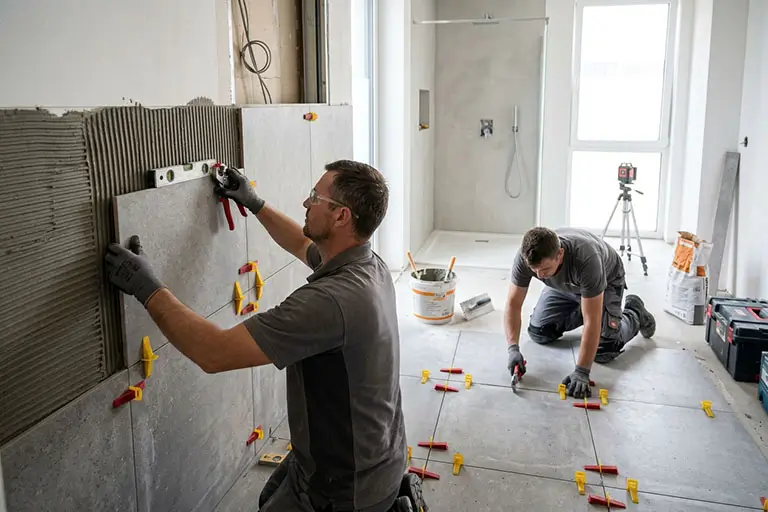
A professional tile installation requires consistent spacing, proper alignment, and a smooth finished surface. A tile leveling system helps installers control height differences between neighboring tiles and maintain a cleaner layout during both wall and floor applications.
Although the basic purpose of the system is the same, wall and floor installations can require different working techniques. Tile size, surface position, adhesive behavior, and installation direction should all be considered before choosing and applying the leveling system.
Wall Applications
Wall tile installation requires careful control because gravity can affect tile position while the adhesive is still fresh. Larger ceramic or porcelain tiles may move slightly after placement if they are not supported correctly.
A tile leveling system helps keep neighboring tiles aligned during this stage. Clips are positioned between the tiles, and wedges or tightening components apply controlled pressure to reduce lippage.
Floor Applications
Floor tile applications often involve larger working areas and heavier tiles. Small height differences can become noticeable when light reflects across the finished surface.
Leveling clips and wedges help keep neighboring tiles at a similar height while the adhesive cures. This makes the system particularly useful for large-format porcelain tiles and open floor areas.
The floor should be checked for high and low points before adhesive application. A leveling system cannot fully correct a severely uneven substrate.
Adhesive should also be spread consistently. For large tiles, back-buttering may help improve contact between the tile and the substrate.
Installers should move across the floor in a planned direction. This helps maintain consistent joint spacing and prevents unnecessary movement over recently installed sections.
Spacing and Alignment
A leveling system does more than reduce height differences. Many clips also help maintain consistent grout spacing between tiles.
The required grout joint width depends on tile dimensions, edge type, installation area, and manufacturer recommendations.
Rectified tiles may allow narrower joints, while non-rectified tiles may require slightly wider spacing. The selected clip should match the desired joint width.
During both wall and floor applications, alignment should be checked regularly. A straightedge or spirit level can help identify problems before the adhesive cures.
Using the same system and clip size across the installation helps create cleaner grout lines and a more balanced finished surface.